Dumpster Diving With Dignity: Why the Thrift Store Hunt Destroys Big-Box Shopping Every Single Time
Let's be honest about what shopping at Target actually feels like. You walk in for toothpaste. You leave forty-five minutes later holding a throw pillow, a set of matching ceramic planters, and a $22 scented candle that smells like "coastal driftwood," which is not a real smell. You have spent $187. You feel nothing. You felt nothing the entire time. The whole experience was as emotionally resonant as refreshing your email.
Now let's talk about what it feels like to find a 1987 ceramic owl wearing a graduation cap at a Salvation Army in suburban Ohio for $1.49.
That owl changes you. That owl means something.
Your Brain on the Hunt
Here's the thing that the wellness industry keeps trying to bottle and sell back to us: genuine unpredictability is one of the most potent dopamine triggers the human brain can experience. Neuroscience nerds call it a variable reward schedule. Slot machines use it. Social media feeds use it. And thrift stores — completely by accident, through the chaotic beauty of donated chaos — use it better than either of those things.
When you walk into a Target, you already know what you're going to find. Not the specific item, but the category of item. Everything is color-coordinated. Everything has been focus-grouped within an inch of its life. The aesthetic has been pre-approved by seventeen committees and a mood board that says "cozy modern farmhouse with a twist." There is no twist. There is never a twist.
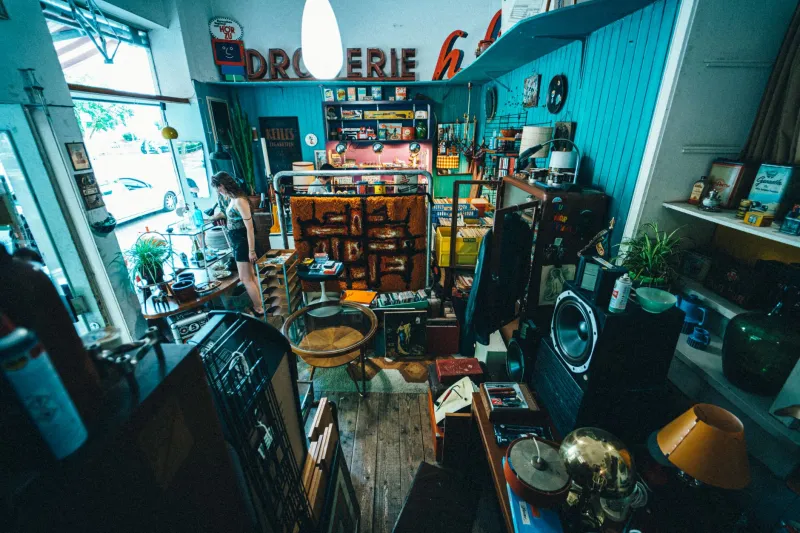
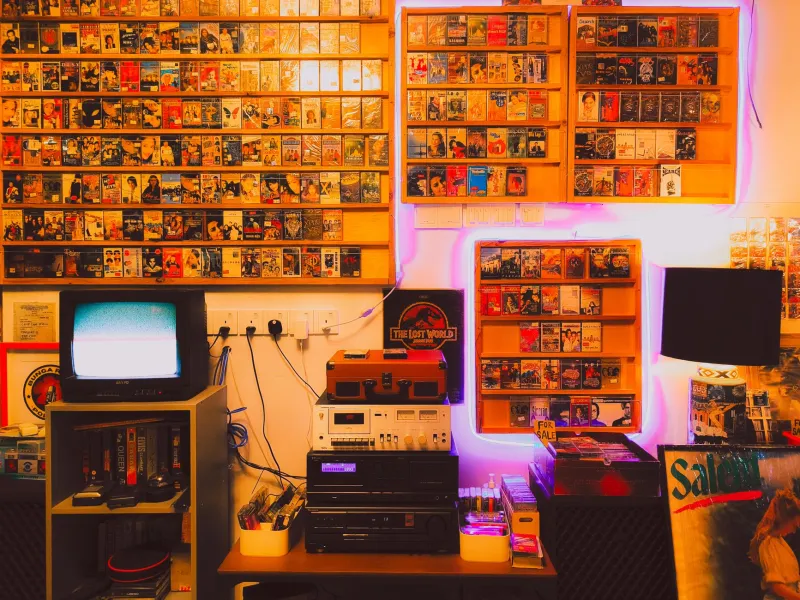
When you walk into a thrift store, you have absolutely no idea what's in there. It could be a complete set of Tupperware from 1974. It could be a fur coat that belonged to someone's grandmother who clearly had opinions. It could be a framed cross-stitch of a wolf howling at a moon that someone spent three years making and then donated, which is a tragedy we don't have time to fully process right now. The point is: anything could be in there. And your brain knows it. And your brain loves it.
Mass Production Killed the Vibe
There's a specific kind of sadness that comes from buying something new from a big-box retailer and then seeing the exact same thing in four of your friends' apartments. You bought a personality piece. It became wallpaper. This is what happens when objects are manufactured at scale by companies whose entire business model depends on you not thinking too hard about what you're buying.
Thrift stores are, functionally, the opposite of that. Everything in a thrift store existed before it got there. It had a life. It has context — even if you'll never know what that context was. The vintage bowling shirt with someone's name embroidered on the chest isn't just a shirt; it's a mystery. Who was Gary? Why did Gary stop bowling? Is Gary okay? You don't know. You'll never know. But you're wearing Gary's shirt now, and that is both haunting and incredibly cool.
This is the core appeal for anyone who's ever felt vaguely alienated by the endless scroll of identical products on Amazon. Mass production flattens everything into sameness. Thrifting restores the possibility that objects can be genuinely, specifically weird.
The Archaeology Angle
Real thrift store devotees don't shop — they excavate. There's a methodology to it. You work the racks systematically. You check the back corners where the genuinely unhinged stuff gets pushed when employees don't know what to do with it. You flip over ceramics to look at the maker's marks. You hold garments up to the light to check the fabric weight. You develop instincts.
This is not how anyone shops at Walmart. Nobody is developing instincts at Walmart. You go in, you find the thing that was advertised to you, you leave. The entire experience is designed to eliminate friction and decision-making. It is optimized. It is efficient. It is completely devoid of the particular joy that comes from spending forty minutes in a bin of tangled costume jewelry and emerging victorious with a brooch shaped like a lobster that you didn't know you needed until it was in your hand.
The hunt is the point. The hunt is half the product. When you find the thing, the story of how you found it becomes inseparable from the thing itself. "I got this at Target" is not a story. "I found this at a Goodwill outside of Tulsa and the woman at the register told me it used to belong to a retired circus performer" is a story you will tell for the rest of your life.
Weird Stuff Finds Weird People
There's a self-selection process that happens in thrift stores that doesn't happen anywhere else in retail. The people who are willing to sort through racks of unlabeled chaos to find one perfect thing are, almost by definition, people with a specific relationship to objects and aesthetics. They're not looking for what everyone else has. They're looking for the thing that nobody else thought to want.
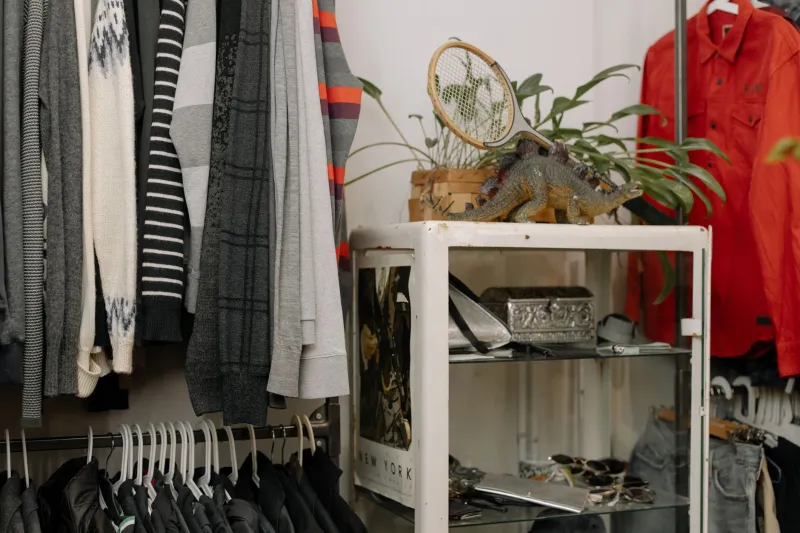
This is the unofficial Ugly Monkey Shop philosophy made tangible: the best stuff is the stuff that got overlooked. The garment that didn't fit any category. The collectible that fell out of fashion before it was ever really in fashion. The piece of décor that is so specific and so strange that it could only possibly appeal to exactly one type of person — and you are that person, and you found it, and it costs two dollars.
Big-box retail is built around the average consumer. Thrift stores, through pure statistical chaos, accidentally serve everyone else.
The Two-Dollar Trophy
There is a particular pride that comes with thrift store finds that has nothing to do with price and everything to do with effort. You didn't just click a button and wait three days. You showed up. You looked. You had to develop an eye for it. You had to know what you were looking for, or at least be open enough to recognize it when it appeared.
That $1.49 graduation owl isn't just a weird ceramic bird. It's proof that you are the kind of person who goes looking for weird ceramic birds, and that you found one, and that it is now yours. No algorithm recommended it to you. No sponsored post put it in your feed. You just walked into a fluorescent-lit room full of other people's former belongings and you emerged with something that is now, completely and irreversibly, yours.
Target cannot give you that. Target will never give you that. Target will give you a very reasonable return policy and a loyalty points program, which is fine, but it is not the same thing.
Go find your owl. It's out there.