Pay More for Worse: The Booming Economy of Aggressively Ugly Stuff
Let's establish something uncomfortable right up front: the ugliest item in the room is probably the most expensive one. Not by accident. Not because the designer had a bad day or ran out of good ideas before the deadline. On purpose. Aggressively, philosophically, joyfully on purpose.
Welcome to the ugliness premium — the counterintuitive pricing phenomenon where deliberately offensive design commands a markup that would make a minimalist weep into their clean white walls.
How Did We Get Here, and Who Do We Blame
The short answer is that we got here the same way we always get anywhere interesting: someone broke the rules and got paid for it, and then everyone else followed.
The longer answer involves a decades-long cultural negotiation between what "good taste" is supposed to mean and who gets to decide. For most of the twentieth century, the design world operated on a pretty clean hierarchy. Beautiful, refined, and understated cost more. Loud, clashing, and chaotic cost less. You could tell a lot about someone's bank account by how neutral their kitchen was.
Then something shifted. Designers — particularly in fashion and ceramics, though the disease spread quickly — started noticing that the guardrails of taste were themselves a kind of conformity. And conformity, as any teenager who's ever dyed their hair a color not found in nature can tell you, is deeply uncool.
So they started making ugly stuff. Intentionally, expensively ugly stuff.
The Lumpy Ceramic Situation
Nothing illustrates the ugliness premium more clearly than what happened to artisan ceramics over the last decade. There was a moment — you probably remember it — when every coffee shop in America was serving lattes in identical white cups with clean lines and a matte finish. Tasteful. Inoffensive. Boring enough to use as a screensaver.
Then the lumpy ceramics arrived.
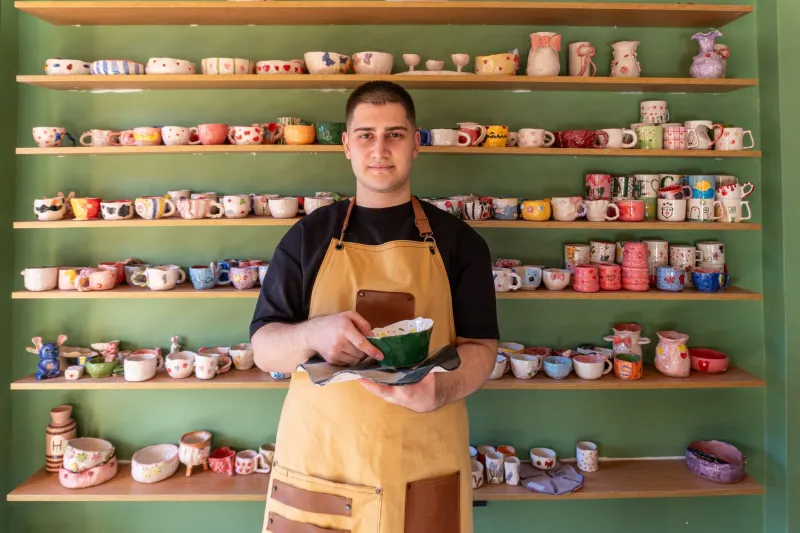
Handmade mugs with uneven rims, glazes that looked like something had gone very wrong in the kiln, handles attached at angles that suggested the potter had been mid-sneeze. These were not accidents. These were design choices. And they cost three to four times what the clean white cups cost.
The reasoning, if you ask the ceramicists making them — and people have, at length, in countless design publications — is that imperfection signals humanity. It signals that a human being with a body and a personality and a specific weird Tuesday afternoon made this object. You're not paying for flawlessness. You're paying for evidence of existence.
Which is either very profound or a masterclass in reframing, depending on your mood.
Fashion's Love Affair With Looking Bad on Purpose
High fashion has been running this play for years, but the mainstream finally caught up around the time Balenciaga started charging four figures for sneakers that looked like they'd been worn through a construction site and then left in a parking lot for a season.
The ugly sneaker trend — chunky, deliberately awkward, with soles thick enough to survive a minor geological event — became one of the defining aesthetic stories of the last decade. And the uglier the shoe, the higher the resale value. This is not a bug. This is the product.
Collaborations between luxury brands and deliberately tacky aesthetics followed the same logic. When a high-end label teams up with something aggressively un-chic — a fast food chain, a dollar store, a brand that your uncle associates with lawn care — the resulting merchandise sells out in minutes and resells at multiples of retail. The joke is the product. The joke costs more than the non-joke.
What the Economists Say (It's Weirder Than You Think)
Economists who study luxury goods have a framework for this, though they use considerably less fun language than "aggressively ugly."
The core concept is Veblen goods — items where demand increases as price increases, because the price itself is part of what you're purchasing. Expensive ugly stuff operates in this zone, but with an additional layer: the ugliness functions as a filter. If you get it, you're in. If you don't get it, you're out. The aesthetic offense is a membership test.
This is why intentionally hideous products tend to cluster in categories with strong community identity — streetwear, indie ceramics, niche fashion — where the ability to recognize and appreciate the bit is a form of social currency. You're not just buying a lumpy mug or a shoe that looks like a retired orthopedic device. You're buying proof that you understand what's happening.
The Ugly Monkey Position on All of This
Look, we sell weird stuff. That is our whole thing. So we have some skin in this game and we're not going to pretend otherwise.
But here's what we actually believe: the ugliness premium is only legitimate when the ugliness is doing real work. When it's expressing something — a refusal to be tasteful on command, a commitment to personality over polish, a genuine love of the chaotic and the strange — then the price tag makes a kind of sense. You're paying for a point of view.
When it's just a brand slapping a distressed texture on something and charging extra for the distressing, that's a different situation entirely. That's not ugly with conviction. That's ugly as a costume.
The real stuff — the ceramics made by someone who actually loves asymmetry, the fashion by designers who are genuinely offended by clean lines — that's worth something. Maybe even worth more than the beautiful version.
The beautiful version, after all, is everywhere. How much does everywhere cost? Not that much, it turns out. Everywhere is practically free.
Weird, specific, committed ugliness? That's the rarer resource. And rare things, as any collector will tell you between purchases they absolutely cannot afford, cost what the market says they cost.
The market, apparently, says a lot.