Going So Hard on One Weird Thing That the Internet Pays You for It
At some point in the last five years, the internet quietly renegotiated its relationship with obsession. The deal used to be: have a broad appeal, make content for everyone, sand down the weird edges. The new deal is different. The new deal is: find the thing you care about more than any reasonable person should, go completely unhinged on it, and watch the audience find you.
This is not a metaphor. This is a documented economic phenomenon, and it is producing some of the most genuinely entertaining content on the internet right now.
The Algorithm Changed Its Mind About Niche
For a long time, conventional social media wisdom held that niche content was a ceiling, not a launchpad. You could build a small, loyal audience around a specific interest, but you'd plateau. You'd never break through to the mainstream numbers that translated into real income. The advice was always to broaden out, diversify your content, appeal to more people.
TikTok essentially set that advice on fire.
The For You Page doesn't care about broad appeal. It cares about engagement depth — how long people watch, whether they comment, whether they send it to someone. And it turns out that deeply specific content produces engagement that generalist content simply cannot match, because the person who stumbles onto a video about the specific clicking mechanism of a 1958 Seth Thomas mantel clock and stays to watch the whole thing is more engaged than someone passively scrolling through a lifestyle vlog.
The algorithm found the obsessives. And the obsessives found their people.
The Profiles You Didn't Know You Needed
Let's talk about some real archetypes, because the pattern repeats across categories in ways that are almost eerie.
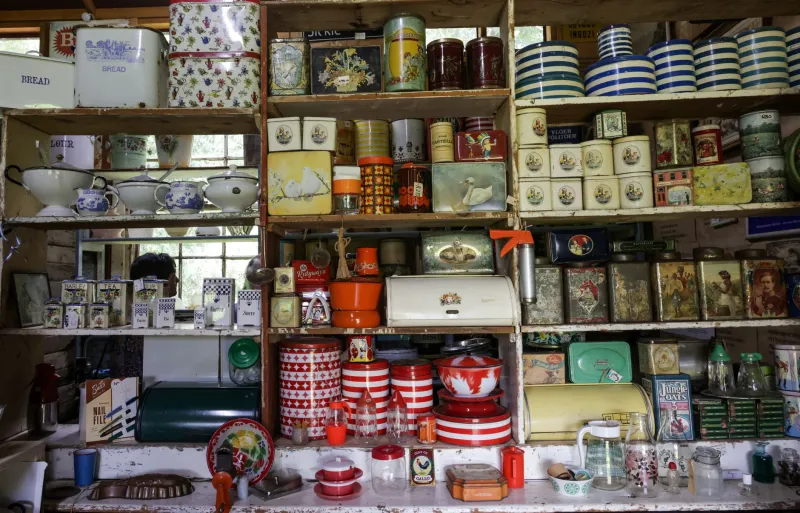
There's the vintage packaging person. She started posting photos of old candy wrappers she'd been collecting since childhood — Bonkers, Chewels, regional brands that disappeared before most of her followers were born. She expected maybe a hundred people to care. The first video where she explained the specific printing technique used on a 1987 Reggie! bar got 400,000 views. She now does brand deals with retro candy subscription boxes and runs a paid newsletter.
There's the failed reality TV archivist. He got into collecting memorabilia from reality shows that were cancelled after one episode — the promotional materials, the contestant headshots, the branded merchandise that never sold. He posts deep-dive videos about shows most people have completely forgotten. His comment sections are full of people writing things like "I was a producer on this show and I am crying" and "I auditioned for this and did not make it and I need to talk to you."
There's the person who reviews regional fast food items from the nineties using only her memory and whatever documentation she can find online. She has no food. She has only vibes and a collection of paper placemats. She has 180,000 followers.
Why Hyper-Specific Works Better Than You Think
Here's the counterintuitive math: a smaller, more passionate audience is more valuable than a larger, indifferent one. Micro-influencers — generally defined as accounts with between ten thousand and a hundred thousand followers — consistently outperform macro-influencers on engagement metrics. Their audiences are there on purpose. They sought out that specific content. They're not passive.
For brands that sell to specific communities — and that category is much larger than it used to be — a micro-influencer with a highly engaged niche audience is more useful than a general lifestyle account with ten times the followers. The conversion rates are better. The audience trusts the creator more. The whole thing works more like a recommendation from a knowledgeable friend than an advertisement.
Which means that the person who went extremely hard on vintage alarm clocks isn't just building an audience. They're building a credible voice within a community. And credible voices in communities are, in the current economy, worth real money.
Discord Is Where the Real Economy Lives
The TikTok following is the top of the funnel. The Discord server is where the actual community infrastructure gets built. This is the pattern that keeps emerging across niche creator communities: someone builds a following on a short-form video platform, then moves the most dedicated fans into a Discord server where the conversation gets deeper, more specific, and more valuable.
These servers are not small talk. They're operating like specialized research communities. The vintage alarm clock Discord has channels dedicated to specific manufacturers, specific decades, specific mechanical complications. Members share acquisition sources, authentication tips, restoration techniques. New members get onboarded by veteran members. Knowledge compounds.
And then, because this is America and someone is always going to figure out how to monetize a community, the creator starts selling things. Not aggressively. Not like an infomercial. More like: "I found fifty of these at an estate sale and I know you want them" or "I made a zine about the 1962 production year and it's twenty dollars" or "I'm doing a paid workshop on basic restoration and twelve people can join."
None of this was the plan. It never is. That's kind of the whole point.
The Loneliness Problem That Niche Content Solved
Before we wrap this up in a bow made of engagement metrics and brand deal revenue, let's acknowledge the thing that's actually driving all of this: people with specific, unusual interests were lonely.
If you grew up obsessed with nineties regional candy wrappers in a town that did not share your enthusiasm, you had essentially no one to talk to about it. Your interest existed in isolation. You kept it quiet. You maybe felt a little weird about it.
Now you have a community of four thousand people who send you packaging they find at estate sales, argue passionately about the correct way to store cellophane, and show up in your comments to say that a specific candy you mentioned was their entire childhood. You are not the weird one anymore. You are the expert. You are the center of a community that wouldn't exist without you.
The income is nice. The sponsorships are nice. But the thing that keeps people doing this — the thing that makes the content feel genuine and the communities feel real — is that it solved a problem that nobody had a solution to before.
You can be obsessed with the specific thing. You can go as hard as you want. The internet will find the other people who needed you to exist.
Go find your weird thing. Go extremely hard on it. We'll be watching.